
Revelation in St. George
As noted in our last post, Electa and Edwin Westover, mother and son, went into the St. George Temple on February 15, 1877 to do the temple sealing of Electa to her long-dead husband, Alexander. It was a Thursday.
A little more than a week later, on Friday the 23rd of February, they were recorded again in the temple doing sealing work, this time for Electa’s parents, Obediah and Rebecca Beal.
Both Erastus Snow and Wilford Woodruff were there.
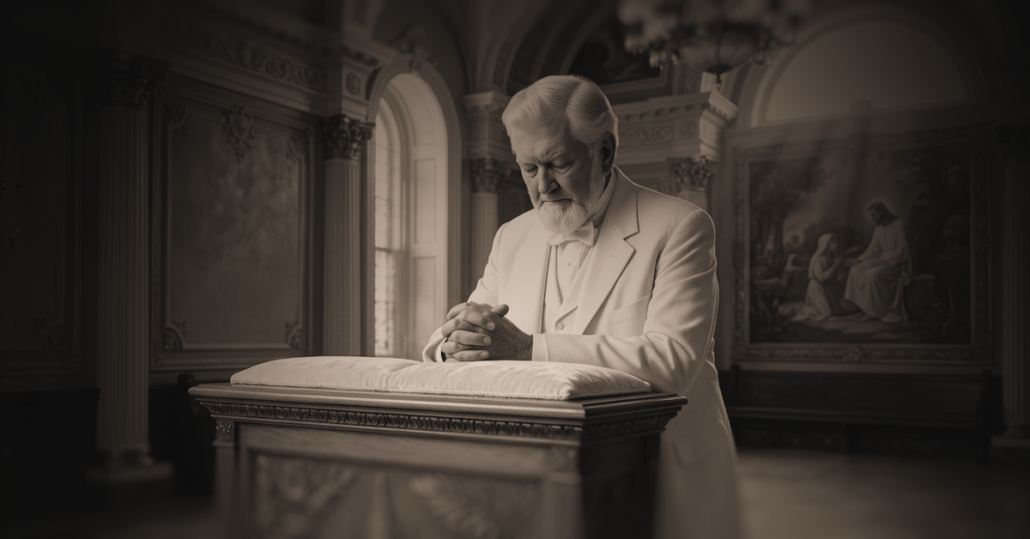
It was on that same date, February 23, 1877, that Wilford Woodruff, while kneeling at an altar in the temple prayed. He asked a question and received a revelation.
What he was told in the revelation may not surprise those who participate in temple worship today. But for 1877 it was a radical idea – one that surprised even Wilford Woodruff.
It was not the first – or the last – revelation in St. George.
~ Edwin’s Blessings ~
St. George was the first temple built since Nauvoo, some thirty years before. Not only had much changed and had been learned about the ordinance work in temples but the anticipation of the temple in St. George opening was off the charts.
In the fall of 1876, Albert Smith and family took a trip to Toquerville from their home in Manti – a pretty long trip at the time (220 miles).
Albert, then 72, said this in his journal: “It being on 24 miles from St. George we went there to see the Temple. I shall not describe the building. I will only say that it was finished outside….it is white as the driven snow. It is worth going some way to see….”
Albert was far from the only one curious about the St. George Temple.
For the Westover’s living and working in Washington County the temple had since its announcement dominated Church activity.
Men, women and families adjusted their work and financial routine to build the temple. Both Edwin and Charles are on record not only donating time but donating significant labor to help build the temple.
Spiritual preparations were being made well in advance of the temple opening.
Brigham Young, who oversaw the temple construction process, visited the St. George area frequently and spoke of the temple opening.
He was well aware that Church members after 30 years were unprepared to resume temple worship.
Those who experienced the temple in Nauvoo barely had any experience in the temple there. “Everything at Nauvoo went with a rush.” Brigham said. “We had to build the Temple with the trowel in one hand, the sword in the other.”
The record shows that while pioneer Utah was absent of a full functioning temple Brigham Young and other Church leaders – specifically Wilford Woodruff and Erastus Snow – spoke of temple worship continually.
“We shall not only build a Temple here [Salt Lake City]”, Brigham said in 1854. “If we are successful, and are blessed and preserved, but we shall probably commence two or three more, and so on as fast as the work requires, for the express purpose of redeeming our dead. When I get a revelation that some of my progenitors lived and died without the blessings of the Gospel, or even hearing it preached . . . I will go and be baptized, confirmed, washed, and anointed, and go through all the ordinances and endowments for them, that their way may be open to the celestial kingdom.”
By 1870, just as he was beginning to push for settlement in Arizona territory, Brigham grew very aware of his own mortality and knew he would not live long enough to see the completion of the temple in Salt Lake City. He made the suggestion to local church leaders in St. George of opening a temple there.
Why St. George?
Brigham explained: “You may take the people of St. George, or you may take the little settlements of Washington, Harrisburg, and Leeds and I will say that the people of St. George, or the people of these little settlements . . . are better able to build the contemplated Temple in St. George than the whole Church could build the Temple in Kirtland, or than the whole Church could build the temple in Nauvoo. I was there. I knew the circumstances of the Church at the building of the Temple at Kirtland and at Nauvoo. And I know the circumstances of the people in St. George and in these settlements named.”
Electa and Edwin Westover had urgent needs for a temple. Both had lost spouses before they had joined the Church. For Edwin we possess some evidence not only that temple work was on his mind but that the Lord was aware of it as well.
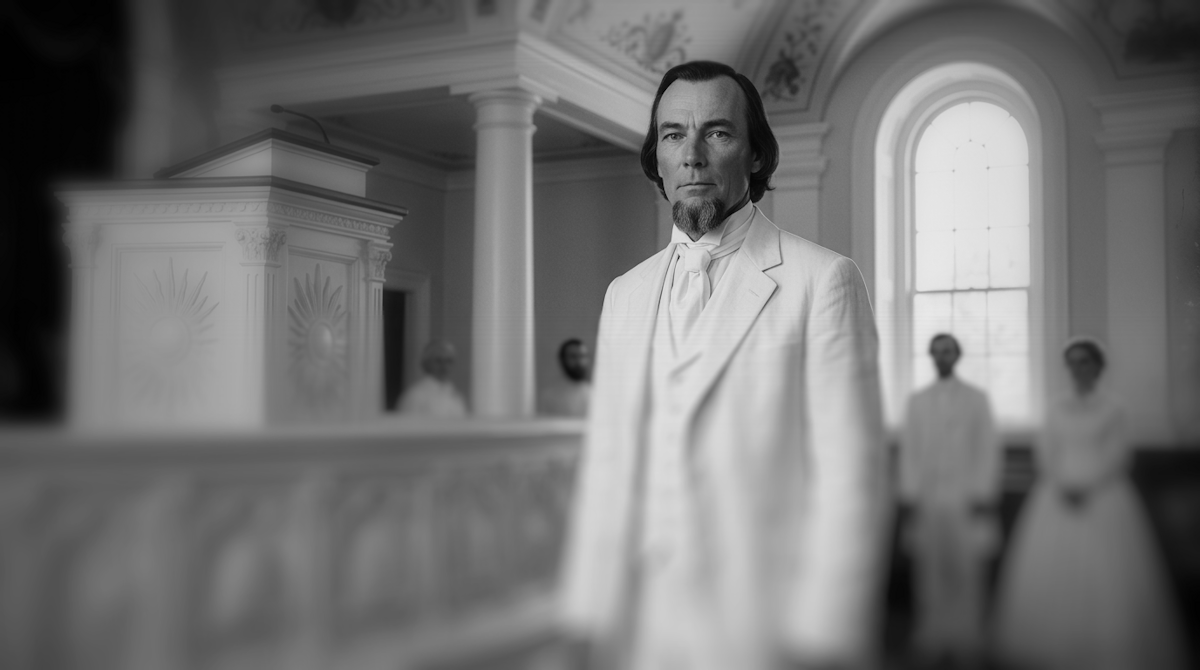
An AI-generated image depicting Edwin R. Westover in the St. George Temple
It was not uncommon for Church members to receive more than one patriarchal blessing in the 19th century. Edwin, and his mother Electa, both had blessings at the hand of Patriarch John Smith in the 1850s.
25 years later, while living in Hamblin and participating in activities in building the St. George Temple, Edwin received another blessing (he requested it), this time at the hands of John L. Smith, the son of the patriarch who had given him a blessing in the 1850s in the Salt Lake Valley. This blessing was much more temple specific for Edwin:
“…I place my hands upon thy head and ask God the Eternal Father to increase thy faith, that there may be no doubt in thy heart, for a mighty work is placed upon thy shoulders and many of thy kindred are awaiting thine action for their release from the prisons where the law of the Gospel confines them…”
Then, on January 27, 1877 in St. George – just weeks before going to the St. George temple – Edwin received a 3rd patriarchal blessing:
“…You will be at that great feast – the Sup of the Lamb…with the wives given you of the Lord, and your posterity will be great and useful in the Holy Priesthood…they will drink with you at your own table, you will talk together about many things…and your eyes will be open and you will know them by name…then you will go to the temple of the Lord…”
How could these blessings have stirred the heart of the postmaster at Hamblin, a man who for the better part of 15 years had been a shepherd in some of the most remote places of Utah?
His understanding, given his circumstances, may not have been complete.
But he went to the temple in faith and found Wilford Woodruff there awaiting him, dressed all in white.
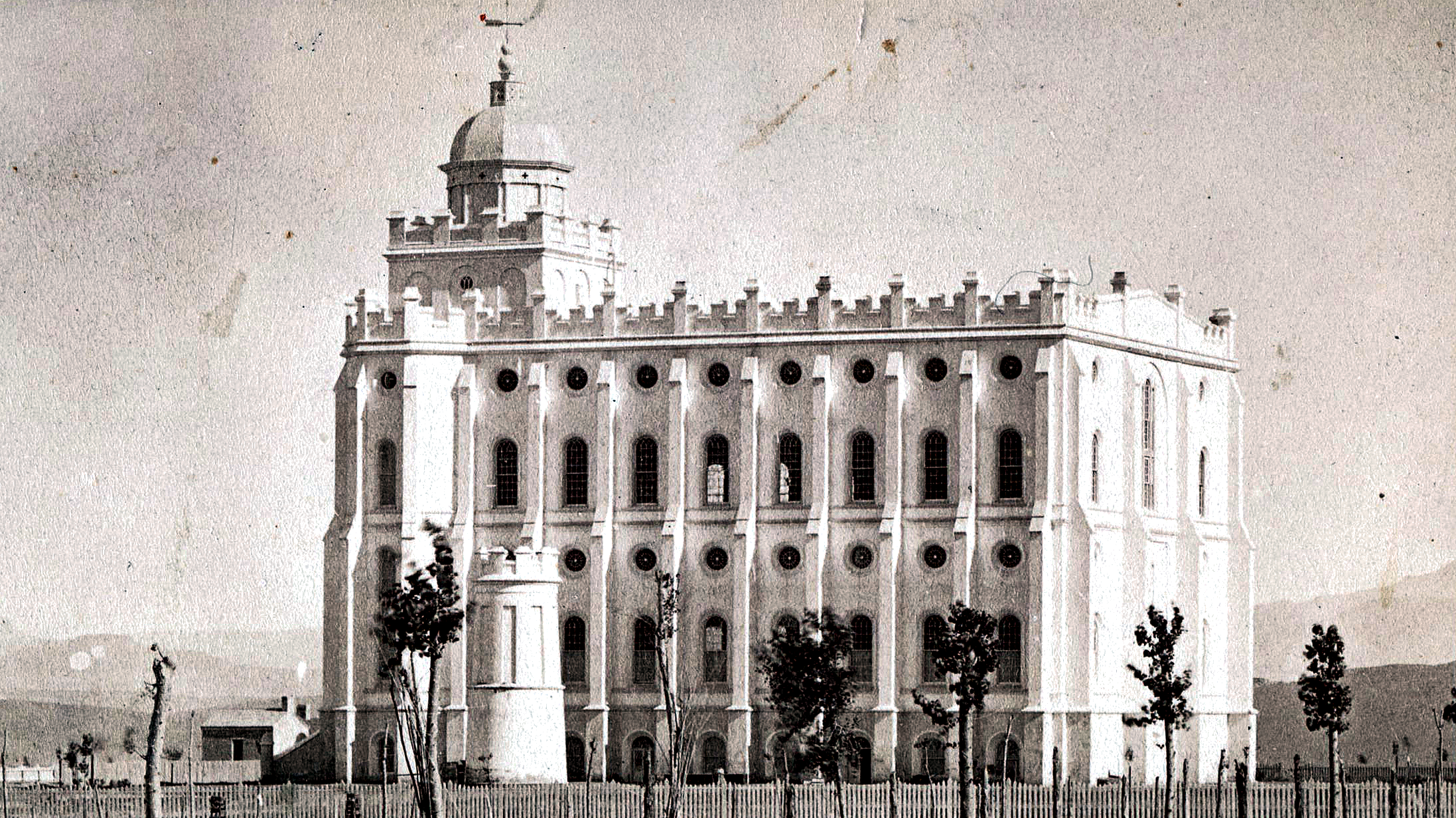
This is the St. George Temple as it was photographed in 1877 around the time of the dedication
~ Wilford’s Revelation ~
Wilford Woodruff was a visionary man.
His daily journal tells of dreams, visions and revelations on a constant basis.
Wilford joined the Church in 1833 and almost immediately, like many young men of the time, engaged in missionary work. He was called as a Seventy in 1835 and then as an Apostle in 1838. He did not ascend to the presidency of the Church until 1889.
What then were the revelations given to Wilford before 1889?
Those revelations pertained to his personal life and to the work he was doing under the positions he held. Wilford Woodruff was a prayerful man.
The work in the St. George temple was both an assignment from Brigham Young and a personal endeavor for Wilford Woodruff.
He had obtained the names of 3000 of his ancestors and was anxious to do all of their temple work. He said:
“What greater calling can any man have on the face of the earth, then to hold in his hands the power and authority to go forth and administer the ordinances of salvation. You give unto any soul the principles of life and salvation and administer these ordinances to him, and you become an instrument in the hands of God of the salvation of that soul. There was nothing given to the children of man that is equal to it.”
Realizing that temple ordinances beyond baptism were going to require a lot of time and work, Wilford ran into a further dilemma in that he just couldn’t do all the work himself.
In placing ordinance work in order, under the command of the Lord through Brigham Young, Wilford could see that he could not do the ordinance work for the women of his family.
He also realized that every member of the Church would have this same problem.
Men needed to do the work for the men, women needed to do they work for the women.
What could he do about that? This was his question to the Lord at the temple altar on the 23rd of February 1877.
Wilford later testified: “the Lord told me to call upon the Saints in St. George and let them officiate for me in that temple and it would be acceptable.”
To temple worshipers today this seems obvious. But to Wilford and the general Church membership in 1877 this was a radical idea.
“Light burst upon my understanding. I saw an effectual door open to me for the redemption of my dead. And when I saw this I felt like shouting glory hallelujah to God and the Lamb. . . . This principle has given me great joy unspeakable at the thought that I can live on the earth to behold my numerous friends redeemed who are in the spirit world.”
On March 1, 1877 – Wilford’s 70th birthday – 154 women from the St. George area organized the effort to do the ordinance work for the Woodruff family.
[Who were those women? Were any of our family involved?]
What Wilford may not have known in receiving this revelation was how it would change how all temple work was done.
Clearly, as Wilford said many times thereafter, temples were made to link families through the priesthood.
But the ability to have people who were not family members do work for others who never got to hear the Restored Gospel changed the scope of temple work. The possibilities were endless.
That is why the revelation did not end there.
~ Visits of Eminent Men ~
On August 19th, Wilford Woodruff wrote in his journal that the Founding Fathers, the signers of the Declaration of Independence, had come to him, with George Washington as the spokesman, and asked for their work to be done.
Just weeks later, speaking at the funeral for Brigham Young, Wilford said:
“The dead will be after you, they will seek after you as they have after us in St. George. They called upon us, knowing that we held the keys and power to redeem them. I will here say, before closing, that two weeks before I left St. George, the spirits of the dead gathered around me, wanting to know why we did not redeem them. Said they, “You have had the use of the Endowment House for a number of years, and yet nothing has ever been done for us. We laid the foundation of the government you now enjoy, and we never apostatized from it, but we remained true to it and were faithful to God. These were the signers of the Declaration of Independence, and they waited on me for two days and two nights. …”
In comparing the spiritual experiences Wilford Woodruff had in the St. George Temple it is clear that his first revelation on February 23rd made his second experience not only possible but understandable.
If Wilford could enlist the help of others in doing his own family work in the temple he could easily help do the work of others such as founding fathers he was not related to. Given Wilford’s call as the president of the then only operating and authorized temple of the Lord, who else would these men have gone to than to Wilford Woodruff?
Wilford immediately set forth to get their work done and nothing could contain him from testifying about it. Others, such as future temple president John D.T. McCallister, would likewise testify of the same vision while carrying out the work for the founders.
Wilford Woodruff’s profile in the Church, if it could be raised any higher, took off with everything that had happened in St. George in 1877.
He was already familiar to several family members on a personal level.
We will explore that more, comparing his personal history to our family history, but isn’t it time we ask this question about Wilford:
Are we related?
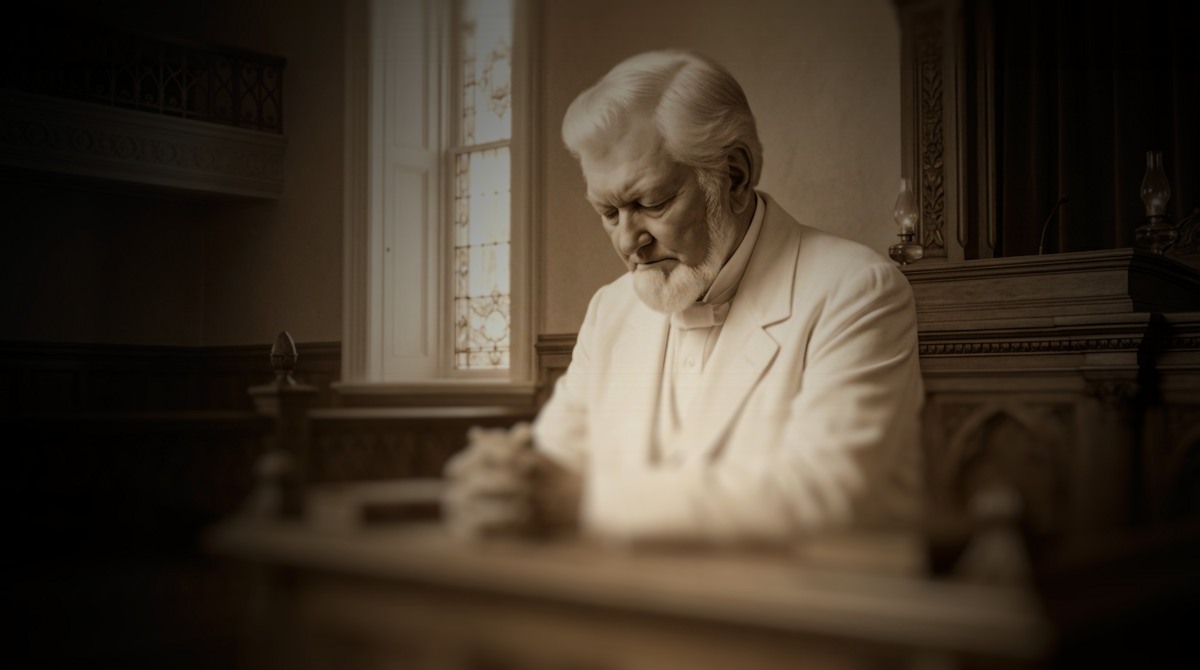
This is an AI-generated image depicting Wilford Woodruff in the St. George Temple
~ Who is Wilford Woodruff? ~
The short answer is yes. We share a common grandfather in an individual by the name of John Day.
John Day is an original American. He was born in Hartford, Connecticut in 1645. His parents were English immigrants.
For context, think back to Jonah Westover, our great grandfather sent to America as an 11-year-old in 1638.
The John Day’s and the Jonah Westover’s were practically neighbors and the history of John Day mirrors that of Jonah Westover in basically the same neighborhood.
John Day is my 8th great-grandfather and Wilford Woodruff’s 4th great-grandfather. Our relation comes via the Albert Smith line (John Day is Albert’s 3rd great-grandfather).
It is curious that Wilford used the language “The dead will be after you, they will seek after you as they have after us in St. George.”
In May, 1883, some five years before the Manti Temple was dedicated, Albert Smith recorded this in his journal:
“As I was meditating on the principles of baptism for the dead, it seems as tho I was surrounded with the spirits of my forefathers opening the principles to my mind, giving me understanding that they was looking to me and my children to attend to those ordinances for them that they cannot attend to themselves. Not only did they open the principles in my mind but they showed me the necessity of my stirring up my children to faithfulness and to so live that we might be prepared when the Temple is finished to go there as well as the brethren and sisters and attend to those ordinances for which the Temple is built. Suffice it to say that I did not sleep none all night for it seemed as tho they was with me till day light opening my mind to many things.”
The visions, dreams, promptings and spiritual awakening brought about by temple work with our ancestors cannot be discounted. There are, frankly, too many examples of these spiritual experiences. We will continue to document them as we discover them.
In our next post we will go back to the history of temple worship and family history from 1830 up until the time of the St. George temple. We hope to supply more context to what family experienced during those years.
- We are All Adopted - June 14, 2026
- The Life of Lewis Burton Westover - May 24, 2026
- Our Family History of Family History and Temple Work - April 16, 2026


Jeff, you are such a Blessing and bearer of Light! Keep on!
I tried to rate this post and it was a 5 star!