
Arizona
My wife, Sandy, is a twin. Her sister, Cindy, married a man named Bud Blazzard.
Several years ago, visiting the grave of grandmother Electa Beal Westover in Washington City, Utah for the first time, I turned to leave, looking down at the ground as I left her headstone. To my great surprise, within just a few feet, I saw a row of headstones all bearing the name Blazzard.
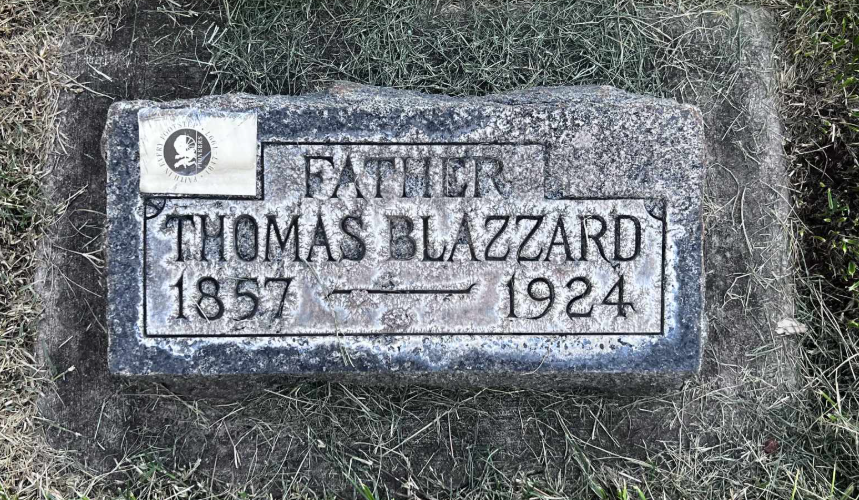
That’s where this twisted pioneer tale of family history and connections begins.
It’s a story that would only begin in Washington City. It is a story that changes the narrative on Edwin Ruthven Westover.
It is a story that also takes us to Arizona – a chapter in Edwin’s history I have avoided because it wasn’t “mine”.
That was a mistake. A big mistake.
It’s also a well of information that I have yet to find the bottom of.
The deeper I dig the more I find I have to keep digging. There have been surprises for me everywhere. This Arizona story affects so many seemingly disconnected parts of our family tree.
~ Nathaniel ~
A little more than a year ago nephew Nathaniel Blazzard (Cindy and Bud’s son) came for a visit to our home in Cache Valley.
Over the weeks he was here I got a chance to take him to Salt Lake where we spent a little time in the Family History Library.
I invited him to ask me anything about where we could do a little research into his family history. To my surprise mentioned a great grandmother — Augusta Maria Outzen Smith.
In my mind, with a married last name of Smith, the immediate question in my mind was whether or not Nephew Nathaniel and I are related in ways beyond the fact that his mother and my wife are twin sisters.
Of course we are!
But we aren’t related in the way that I thought.
The mystery unfolded when we stumbled upon this photo:
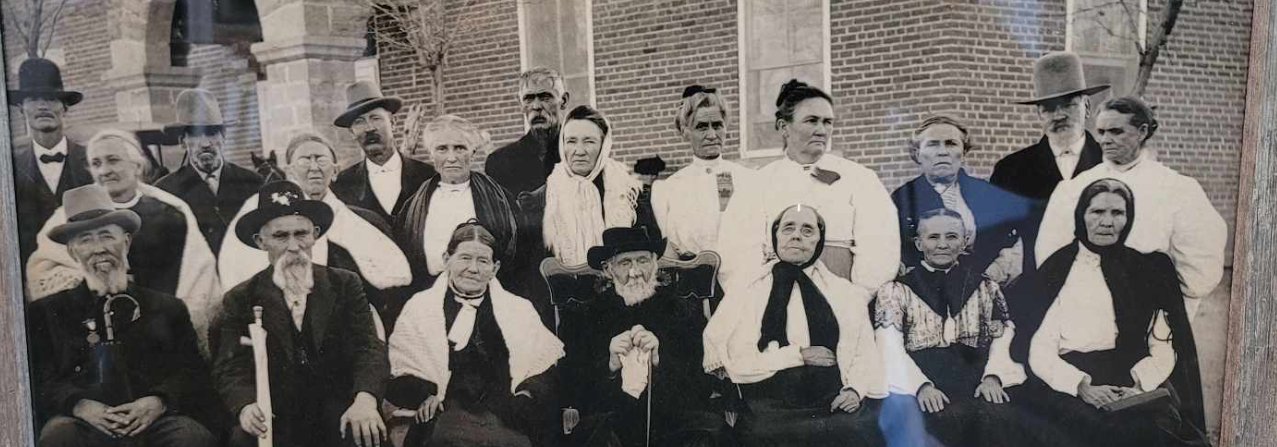
This image was taken in 1908 in Snowflake, Arizona. It is titled “Old Folks Day” and these people are sitting in front of the Snowflake LDS Academy.
Snowflake Arizona is not named after winter weather in that part of the world. Snowflake is a mash-up of the names of two founding fathers of the community – our old friend Erastus Snow and a man named William Jordan Flake.
Brother Flake is pictured above, front row on the far left. In the mid-1870s Flake was assigned, along with Elder Snow, to colonize areas of Northern Arizona Territory.
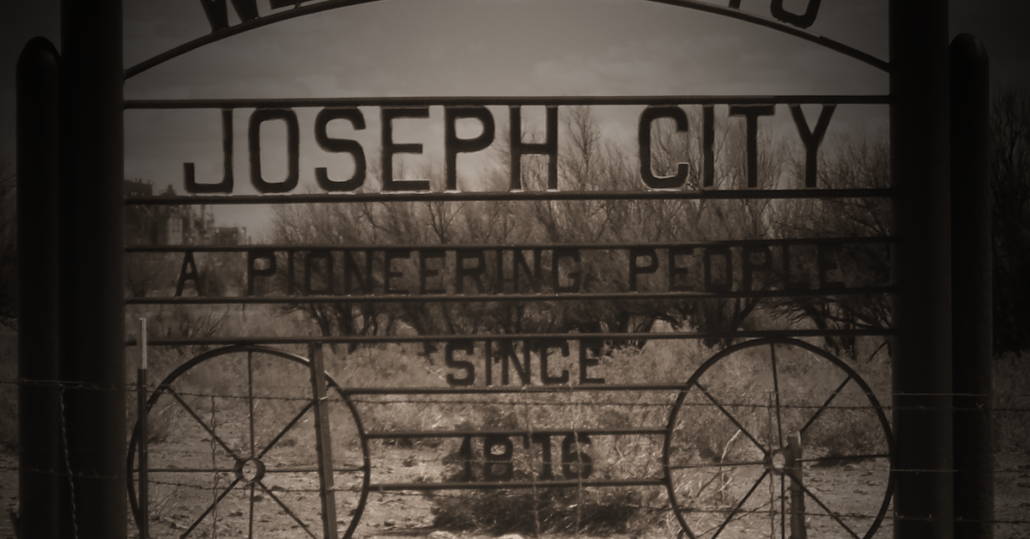
The pioneer communities along the Little Colorado River of Joseph, Taylor, Brigham City Fort, Sunset, Obed, and Snowflake were established between 1876 and 1878.
Today the communities that have survived are Joseph, Snowflake and Taylor, although they remain small with populations ranging from about 1,500 to 7,000 people.
Each of these areas would be touched by many families coming mostly from Southern Utah – including the Westovers and the Blazzards from Washington City, Utah.
~ Why Brigham Wanted Northern Arizona Settled ~
Before I get into the individual history of the people pictured above and into the stories of other family members there are some things to understand about Arizona and why they were sent there.
As early as 1873 Brigham Young sent scouts into Northern Arizona to look at where new communities could be established.
He had four reasons for wanting to establish a foothold in Arizona:
First, he wanted to expand his visionary “state of Deseret”.
Second, he wanted to expand the United Order.
Third, he wanted to proselytize to the Hopi, Apache and Navajo people.
And fourth, Brigham wanted locations out of reach of federal authorities pursuing those practicing plural marriage.
Each of these things were accomplished by Brigham through family members like ours who settled there in the 1870s and 1880s.
Brigham put together a list of 200 families, roughly 40 from Northern Utah and the rest came from areas settled in Southern Utah, and sent them to pioneer.
Lot Smith, George Lake, William C. Allen and Jesse O. Ballinger were appointed presidents of the pioneering companies. They would all travel to Kanab to organize the parties in early 1876 before exploring areas near the Little Colorado for permanent settlements.
It was never going to be an easy assignment.
In fact, just getting to Kanab from all points in Utah proved to be problematic that winter/spring of 1876 due to heavy spring snow.
Lot Smith was leading a group from Draper, Utah and they fought snow the whole way. After struggling to get to Panguitch they faced an even bigger challenge passing through Hatch to get over the divide to Kanab – a distance of just 60 miles. The party had to double back at some point to Asay’s ranch where 50 families were stuck in the snow.
If the journey wasn’t hard enough the destination would prove to be even more difficult. The further south they pushed the worse the quality of the soil and the more scarce the supply of water. There was very little wood with which to build.
The Little Colorado was the focal point for that reason. But even along the river they would explore for hundreds of miles to find places for suitable settlements that could sustain life long term.
There were many differences in settling Arizona versus what Brigham faced when settling Salt Lake.
First of all, these Arizona pioneers were largely seasoned. It happened 30 years after the first arrivals in Utah. The Arizona pioneers were the sons of pioneers and some, like Edwin Lycurgus Westover, knew life on the frontier.
Arizona was also better known in advance of the pioneer parties coming. For years men like Jacob Hamblin had traveled Arizona and already knew the native inhabitants.
The distance traveled also affected the dynamics of the pioneering effort – just 300 to 400 miles separated St. George, Utah from the settlements of Northern Arizona.
This meant that traveling to see family, to worship in the Temple, and to secure supplies was far different than the pioneering efforts to the north.
But there are additional things to consider as we explore the families and individuals involved in settling Arizona.
Like settlers of Utah to the north the pioneers of Arizona in these communities were Mormon and polygamist. Nearly every one of them.
They had to engage in plural marriage. It was not only a tenet of faith. It was a critical component of survival.
And it made many of them outlaws. Well, at least the men. It would be the women who would make it endure.
We need to tell their stories. That is why this is just the first of several posts about the families and individuals in Northern Arizona.
In many ways the day-to-day survival of life in Arizona was tougher than in Utah. The climate was more challenging. The access to water was more difficult. The raising of crops was more limited.
Resources were few. The families who settled Arizona may have arrived there, in many cases, somewhat well off. But they never stayed that way.
To settle in Arizona was to become very poor. Constant sacrifice, doing without, and making do were just a way of life.
Leadership was another critical component of surviving the settlement of Northern Arizona and Brigham did not spare that manpower. Men like Jacob Hamblin shifted their focus from Utah to Arizona to help “build the Kingdom”.
And build they did. The leadership of the church, right down to the Bishops of the tiny towns the pioneering efforts built, was critical for the early decades of the effort. They were embedded in the lives of the families that lived there.
For these families Arizona became a stage of growth and expansion. Generations of legendary efforts and sacrifice has led to legendary stories that need to be shared.
Here are some of the individuals whose stories of the Arizona experience we will share:
• Sarah Jane Burwell, pioneer wife of Edwin Ruthven Westover
• Edwin Lycurgus Westover, infant son of Edwin Westover who became a pioneer of Arizona
• Jacob Hamblin, Apostle to the Indians
• Joanna Eriksson Westover, wife of Edwin Lycurgus Westover and Swedish immigrant who became a fixture in Joseph City, Arizona
• Henry Waters Despain, friend of Edwin Lycurgus Westover
• Florence Rebecca Westover, youngest child of Edwin and Sarah Jane
• James Searcy Blazzard Sr and family, later settlers and long-time Arizona residents
• John Bushman and families, early settler and friend to Edwin Lycurgus Westover
• John Lycurgus Westover, son of Edwin Lycurgus/Henry Despain and Joanna Westover
• Adele Bushman, daughter of John Bushman and wife of John Lycurgus Westover
• David Ernest Farr, husband of Natalia Smith, father of Sylvia Farr Blazzard
• Natalia Smith, daughter of Jesse Nathaniel Smith and Augusta Maria Outzen
• Jesse Nathaniel Smith, East Arizona Stake President
• August Maria Outzen, 4th plural wife of Jesse N. Smith
• Emma Seraphine West, 1st wife of Jesse N. Smith
• Margaret Fletcher West, 2nd plural wife of Jesse N. Smith
• Janette Mauretta Smith, 3rd plural wife of Jesse N. Smith and daughter of Joel Hills Johnson
• Emma Ellen Larson, 5th plural wife of Jesse N. Smith
• Silas Smith, father of Jesse N. Smith
• Laura Matilda Westover Decker, daughter of Edwin Lycurgus and Joanna Westover
• Ella Angelia Westover, daughter of Edwin and Sarah Jane Westover
• Joseph Ernest Westover, son of Edwin and Sarah Jane Westover
• Arthur Leo Westover, son of Edwin and Sarah Jane Westover
• Frances Long Reeves, daughter of Frances Reeves Long Willlis and William Reeves
• John Henry Willis, husband of Frances Long Reeves, founder of Willis Ranch in Snowflake
• William Jordan Flake, founder of Snowflake, Arizona
• John Hunt, Bishop
In addition to the above, we will share a little of journals, notes and histories about Howard N. Blazzard, Viola Greer, Howard Chadwick Blazzard, Trevelyn Greer Blazzard, Mary Ann Blazzard, Thomas Cottam, Wilford Woodruff, Amelia Christena Westover, and many other Bushmans, Flakes, Johnsons, Blazzards, Smiths, Snows, and Westovers.
As you can see from this list of names and connections to Arizona we have tie-ins to many of our family lines.
Cottam, for example, was the maiden name of my father’s 2nd wife, Joanne Cottam. Her family heritage is in St. George where her great grandfather, Thomas Cottam, was a Stake President. He is buried next to Charles and Eliza Westover in the St. George City Cemetery.
Frances Long Willis is daughter to my 4th great grandmother, Frances Reeves Long – who is also mother of Sarah Reeves Riggs, the mother William Reeves Riggs Sr, who is the father of my great-grandfather, William Reeves Riggs Jr.
Sylvia Farr Blazzard – Bud’s Mom – is descended from the Lorin Farr family, which everyone knows descends from the Zerubbel Snow family.
~ What These Connections Mean ~
For more than a year I have endeavored to sort all this out. There are details upon details to share in these stories.
These connections, stories, and histories boil down to this:
1. The pioneering spirit that went into settling Arizona is instructive and inspiring.
2. Because this was just a little bit later than the settlement of Utah, we have better records of women and their stories. They are crucial to understanding what happened.
3. Plural marriage went a whole lot deeper than we realize in making us who we are. The story of polygamy in the American West is NOT what they told us it was. These true stories will give you much to ponder.
4. There is a separation between faith and non-faith evident in these family stories. I will leave outcomes for you to judge but to me the conclusions are obvious.
5. Arizona is still, in my opinion, a terrible place to live. That’s just my opinion based upon personal working experience there. But, it is an important location to explore if only for our great heritage there. I will go there and explore (just not in July).
- The Family Quest of Joseph and Wilford - March 24, 2026
- My Friend Will Harvey - March 9, 2026
- Arizona: Kurg and the Doctrines of Marriage and Adoption - January 19, 2026


Well written. It’s amazing to me how much you’ve found about our family connections! You are a
True Pioneer in this Westover Family turning our hearts to our fathers and mothers. Thanks 🙏 Jeff. Keep on keeping on!