
Arizona: Kurg and the Doctrines of Marriage and Adoption
When Amos and Ruth Westover came to the frontier of Ohio in 1820 they found the land they were looking for: it was teeming with wildlife, there was clear access to good water, there was abundance of timber and long growing seasons in which to farm.
It was just what they were working for.
Nearly 30 years later, their grandsons in Edwin and Charles Westover arrived in a new frontier in a land to be known as Utah. It was an arid desert. Water was tough to find and access. Growing seasons were shorter. Timber was to be found in mountains.
It was just what they were looking for. In their case, it wasn’t water, timber and long growing seasons.
The same could definitely be said of our Arizona pioneer families.
They weren’t going to Arizona because they might be made comfortable and rich.
They were driven by faith.
~ Kurg ~
Edwin Ruthven Westover was born in 1824.
At the age of 20, in 1844 in Ohio, he married a woman named Sarah Sophia Darrow. A little more than a year later, their son, Edwin Lycurgus Westover, was born.
Little Edwin lost his mother when just a few months old. His grandmother, Electa, would be the first mother-figure he would remember.
Together the two Edwins, with Electa and other family members, came west in 1848.
Around that time, three-year-old “Kurg”, as he was called, took on a new mother when his father remarried to a woman named Sarah Jane Burwell.
For an orphan boy who had lost his mother Kurg would come to be blessed by many strong pioneer women in his life. He was surrounded by them.
In 1857, Kurg’s father married young Ann Findley, a handcart pioneer who had come from Scotland with her parents to Utah.
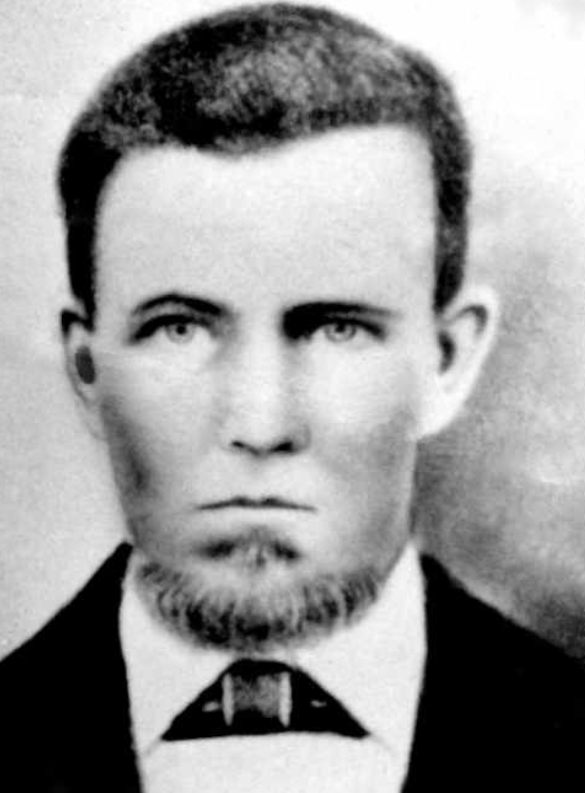
He was known as Kurg
His grandmother, Electa Westover, stayed with the family and thus remained a big influence on young Kurg.
The family moved from Salt Lake to Cottonwood, then for a few years to Grantsville, where Grandmother Electa’s sister – Aunt Hannah, she was called – lived.
In the early 1860s, Kurg’s father was called to serve in the Cotton Mission, taking the family to Southern Utah.
There, in a tiny settlement known as Hebron, Kurg was given military training as part of the local militia.
In 1869, at about the age of 24, Kurg was asked to help the family back up in Grantsville. There he met Joanna Matilda Erickson in 1874, who was about 20 years old when they married.
Uncle Kurg is an important part of what I am about to share with you and so are all of the women in his life.
Every single one of them practiced plural marriage.
~ The Covenant of Marriage ~
There is much to be studied about the LDS doctrine of marriage in our family histories. From the time it was introduced until the present day it has been a topic of controversy, curiosity, condemnation and outright deception.
We have talked about it several times before telling the stories of our ancestors.
For many their stories of plural marriage converged on the year 1856. Others, such as the case of Albert Smith, date back as far as the early 1840s in Nauvoo. Sometimes, even the topic of true love is associated with tales of polygamy.
The difference between our family pioneers in Ohio and those that later came to Utah lies within sacred doctrines of faith like plural marriage.
Those coming to Utah came to practice their faith. And plural marriage was just one sacred doctrine that was unconventional.
Elder Hugh B. Brown, LDS Apostle who lived from 1883-1975, explained that within the LDS faith marriage is a sacrament – a sacred act of faith exercised under authority of priesthood given by God. Marriage is a covenant between man, woman and God.
Jesus in the New Testament said, “Have ye not read, that he which made them at the beginning made them male and female, And said, For this cause shall a man leave father and mother, and shall cleave to his wife: and they twain shall be one flesh? Wherefore they are no more twain, but one flesh. What therefore God hath joined together, let not man put asunder” (Matthew 19:4-6)
Within any covenant there are purposes for every party involved. In the case of the marriage covenant the purpose of God in the union is to raise seed. “Behold, this is my work and my glory, to bring to pass the immortality and eternal life of man”.
Faith, marriage and the “raising of seed” is central to the plan of salvation taught in LDS doctrine.
For a man like Edwin Lycurgus Westover and many other Arizona pioneers like him it was one reason he answered the call to go there.
~ Henry Waters Despain ~
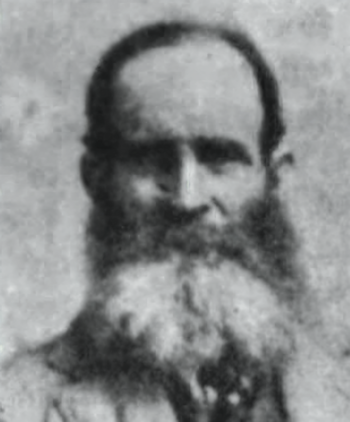
Henry Waters Despain
Born in Illinois in 1847, his parents joined the Church of Jesus Christ of Latter-day Saints, pioneering branches of the Church in Arkansas and Tennessee before coming to Utah in 1861.
The Despain’s settled near Little Cottonwood Canyon, leading some to believe that maybe that’s where Henry and Kurg came to know each other. I doubt this because by the time the Despain’s settled in the valley the Westover’s had moved 50 miles away to Grantsville.
Young Henry was with his family absorbed into community life in the Salt Lake Valley.
He worked on the Salt Lake temple and later as a policeman. He married Grace Porvis in 1869 and with her would raise a large family of 13 children.
He too was called to go to Arizona with his family in 1876.
This is where I think he met Edwin Lycurgus Westover.
~ Kurg and Joanna Westover ~
The same year that Henry Despain got married in 1869 Kurg had moved back north to Grantsville and the home of Aunt Hannah.
Aaron Sceva had been called on a mission and Kurg was needed there to run the family farm.
The story is told of Kurg’s attendance at a church meeting where a young Swedish immigrant named Joanna Eriksson sang.
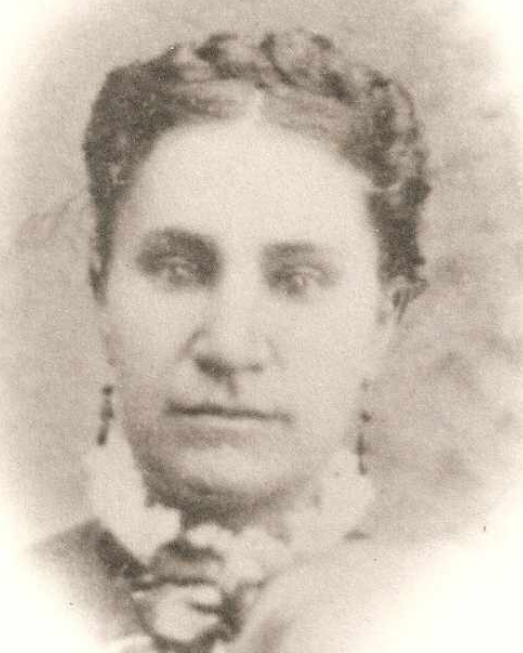 She sang a song, “Only a Little Flower”, and wore a flower in her hair. Kurg is reported as saying, “Anyone who can sing like that I want to marry”. Kurg courted her and they were married in 1874. Joanna was 20 years of age, Kurg was then about 30.
About a year later, their first child, Laura Matilda, was born. Around this time the call to settle in Arizona came.
The Westover’s famously packed a wagon with great thought. They wanted to arrive in Arizona fully prepared for their pioneer experience.
Along the way they met others, such as Henry Despain, headed for the same mission. They became friends.
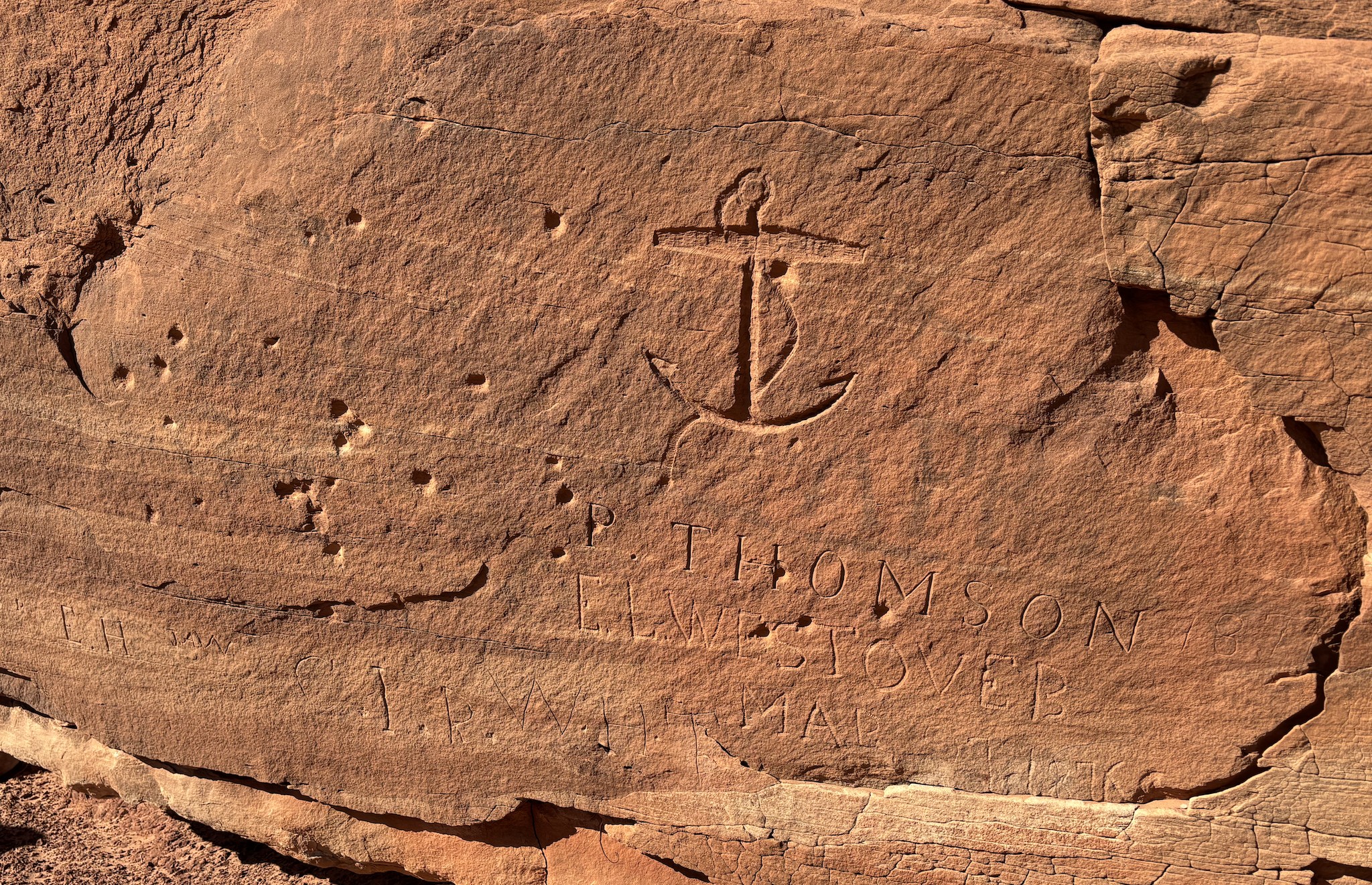
Kurg engraved his name on the rock near Camp Windy in 1876. Courtesy of Grant Davis
Arriving in 1876 with the Allen Camp the Westover’s determined a place for their home and joined the United Order effort in settling in. They gave all they had to the United Order and lived in a hastily erected fort for the first phase of their time there.
Some months after they arrived the Westover’s and others departed for a trip to St. George. Their purpose in the trip centered around the dedication of the St. George temple which drew people in from many areas of Utah and Arizona.
While there, in January 1877, their first son – Edwin Swen, named after his grandfathers – was born.
Three weeks after the birth of Edwin Swen, and after doing family ordinance work in the St. George temple, the Westover’s once again headed for Arizona, this time in company with some other family and church members who were part of the John Hunt Company.
It was spring and the water in the Little Colorado river was high.
In moving wagons and teams some of the livestock struggled. Kurg volunteered to lead them and ended up going under the cold water. After much trouble, the party arrived in Joseph City on April 30th, 1877.
Kurg was never a fully well man due to lifetime issues with asthma. The event in the water in crossing the Little Colorado is believed to have aggravated his health and while on a later trip to New Mexico during the summer of 1877 Kurg expressed to others the feeling he had that he would not live much longer.
Henry Waters Despain was on that same trip.
Later, in a private conversation, Kurg expressed again his feeling that he would not survive and that if he did not he wanted Henry to “raise up seed” to his name by marrying his wife Joanna should he die.
~ The Doctrine of Adoption ~
Like marriage, the doctrine of adoption has ancient Biblical roots. In the New Testament, the Apostle Paul in Romans 8:15 explains we receive “the Spirit of Adoption” through Christ, becoming joint heirs with him.
Paul uses the phrase “the Spirit of adoption” as an analogy for God’s covenant people. When we make covenants with God, we take on Christ’s name. Through our covenants, we become more than His children. We receive the “Spirit of adoption” and become His heirs.
Adoption in LDS priesthood terms relates to marriage and the bringing forth of children, believing that a man can have his kingdom added upon through the doctrine of adoption.
Joseph Smith, in his history, tells of Moroni’s quoting from Malachi: “And he shall turn the heart of the fathers to the children, and the heart of the children to their fathers, lest I come and smite the earth with a curse.” (Malachi 4:6) This was in 1823 – long before the knowledge of temple work, genealogical research and family history. Moroni repeated these verses to Joseph three times and he was left to ponder and research their full meaning for years.
In ushering in the era of temple work to the Church in the 1840s Joseph Smith taught: “…that the earth will be smitten with a curse unless there is a welding link of some kind or other between the fathers and the children, upon some subject or other—and behold what is that subject? It is the baptism for the dead. For we without them cannot be made perfect; neither can they without us be made perfect…”
This beautiful doctrine, supported again in the New Testament by Paul in 1st Corinthians, introduced proxy work for other individuals who otherwise could not perform the ordinances for themselves – turning the hearts of the children and the fathers to each other.
This “welding link” – known as the “sealing” of individuals through marriage and adoption – was pursued by early members of the LDS faith as a means ensuring salvation.
A marriage sealing was the link between a man and a woman. Another sealing is that between parents and children. An adopted sealing is the connection between children and parents, even if they were not naturally born to those parents.
It was believed, as these sacred ordinances were revealed to Joseph Smith, that priesthood sealings where individuals could be sealed via adoption into other families was possible.
Records exist from 1846 to 1894 of many individuals who were “sealed” outside of marriage relationships. One family example of this is in the story of Esther Dutcher Smith, wife of Albert.
An extension of adoption, again outside the marriage relationship, is the “raising up of seed” to another man’s family and having those children sealed through priesthood authority.
This was the case of Edwin Lycurcus Westover and Henry Despain.
~ The Union of Henry Despain and Joanna Westover ~
Shortly after Kurg’s death Joanna Westover took leave of Arizona to return to her parents in Grantsville. She was there for two years and sought the counsel of her parents about her future.
Her father assured Joanna she could return home to Grantsville with her children and that he would see she was cared for.
While there in Grantsville, she received a letter from Henry Despain, who explained what Krug had requested of him – to marry Joanna as a plural wife and raise up seed to Kurg, having the children sealed to Kurg and Joanna.
Joanna thought long and hard of what he was suggesting. She was well aware of the practice. While it wasn’t common it was not unknown.
Others had done it since Nauvoo and others in similar situations as widows had done the same.
As many subsequent histories of Joanna explain, she was not inclined to accept the proposal.
She hesitated in answering and prayed over the situation. Kurg had never said anything to her about such an arrangement.
But a dream, in which Henry Despain appeared, changed her mind.
She knew of Henry Despain but did not know him. But in this dream he stood at an open door, gesturing to her to go through the door with him.
From another history we read, “Henry De Spain was in the doorway, holding out his hand to show her the only way out. She felt impressed by this dream that she must marry him, not for love, nor for security for he already had a family to support, but to comply to her husband’s request. She and Henry were married 27 May 1879, in Salt Lake City, Utah.”
From their union seven additional children would be born by Joanna – all were known as Westover children.
Much more needs to be said about the story of Joanna Matilda Eriksson Westover – and it will, in a separate post.
This complicated twist on plural marriage is just one new insight into our Arizona family history. There are others we will share in individual histories.
For Kurg – whose death preceded his father’s by more than a year – his legacy is dominated by his brief experience in Arizona. It was, in the end, only about two years of his life.
But those two years changed generations. His story is forever part of their story and it is one that requires understanding more than judgment.
Like his father, Kurg pioneered because of faith first.
He answered a mission call. In losing his life he extended his faith by exercising his understanding of the doctrines of marriage and adoption.
Through his faith and his belief, his family – and thus the family of his father Edwin – expanded.
If you go back to Edwin Ruthven’s patriarchal blessing – and all descendants of Edwin Lycurcus, adopted and other wise, are entitled to it – you understand the significance of what Edwin was promised. All of his posterity is mentioned in that blessing.
If you are a descendant of Edwin Lycurgus Westover we strongly urge you to get copies of every patriarchal blessing on that paternal line.
- We are All Adopted - June 14, 2026
- The Life of Lewis Burton Westover - May 24, 2026
- Our Family History of Family History and Temple Work - April 16, 2026

